
Cloud SaaS
Ideal for firms that want rapid launch, managed operations, automatic updates, and a lower entry barrier. Best when internal IT overhead needs to stay minimal.
Fast onboardingManaged updatesScalable


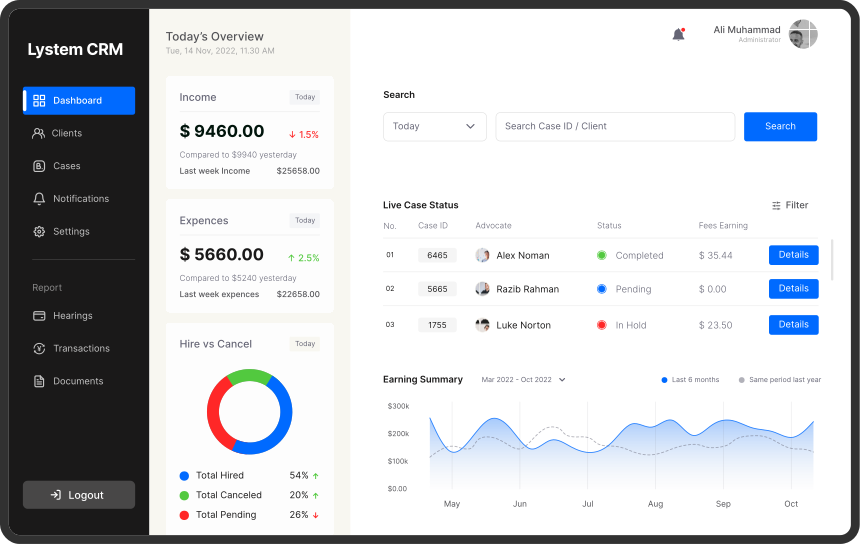
Ideal for firms that want rapid launch, managed operations, automatic updates, and a lower entry barrier. Best when internal IT overhead needs to stay minimal.

Ideal for firms that require internal hosting, direct infrastructure ownership, tighter policy controls, and private AI processing inside their own network.

Ideal when part of the platform can run in a managed environment while sensitive workflows, integrations, or AI layers remain on client-controlled infrastructure.
The AI proposal positions the intelligence layer as fully on-premise, with no reliance on external AI services, no internet requirement after installation, complete audit control, and no ongoing API costs. This makes Lystem particularly well-suited for privacy-sensitive legal environments.
Use SaaS where speed matters. Use on-premise where risk, privacy, or procurement rules demand stricter control. Use hybrid where both realities need to coexist.
Keep the core platform connected through APIs, while allowing mobile, notification, reporting, and AI layers to be aligned to each client’s infrastructure posture.
| Deployment | Ideal buyer | Why it works |
|---|---|---|
| SaaS | Growth-stage law firms | Fast onboarding, lower infrastructure management, managed releases |
| Private cloud | Regional firms with higher policy control | Cloud convenience with stronger tenancy and governance controls |
| On-premise | Enterprise legal teams, government-linked entities | Internal hosting, stronger data residency posture, private AI execution |
| Hybrid | Cross-border and compliance-heavy firms | Balances modern access with internal ownership for selected workflows |
The AI roadmap outlines a three-phase approach over nine months: starting with quick wins, followed by decision intelligence, and then deeper automation once the operational foundation is stable. This same phased strategy can be applied to deployment and rollout planning.